Throughout the 1990s, Longaberger Basket parties were something many people (mostly women) looked forward to.
Held in private homes, if you were invited to a party, you knew there would be snacks, games and a fun time with friends.
You also knew you’d return home with a receipt for a basket—with protector and liner if you could afford the “combo” upgrade.
You could also assume it wouldn’t be the last party you’d be invited to, since the direct-sales marketing plan encouraged friends to encourage friends into hosting parties.
With the second or third Longaberger purchase, you became a collector and you began to differentiate between a market basket and a spring basket.
Next, you probably found a fabric that went best with your kitchen or living room, and patterns such as “Woven Traditions, Market Day Plaid, Orchard Park Plaid, Botanical Fields, Fruit Medley” and “Garden Splendor” entered your vocabulary.
Just when your husband suggested you were acquiring too many baskets, along came an invite to a basket bingo.
Now you could buy a ticket to benefit a good cause and possibly win a basket!
As time went on, the Longaberger company began selling wood items, wrought iron accessories and pottery.
I clearly recall a party where a male Longaberger consultant turned a pottery mug upside down on the carpeted floor and stood on it with one foot to show how durable the pottery was.
That made quite the impression on me and even though I couldn’t afford a set of pottery then, my cupboard is now full of Longaberger mugs that have been surviving a challenging life with a coffee-loving, careless, husband.
But while we sat in the homes of our friends listening to a consultant tell us how we are making an investment not just in quality baskets, but also in the future of our children, because the value of the baskets would increase and we would surely be able to pay for our child’s college education through their resale value, the company’s weave was unraveling in the background.
The Backstory
The beginning of the Longaberger Company dates back to 1896 when John Longaberger began working at the Dresden Basket Factory in Dresden, Ohio.
His son, JW, later joined his dad at the factory and in 1936, JW bought the company and changed its name to the Ohio Ware Basket Company.
That company closed in 1955 and in 1973, JW’s son, Dave, began JW’s Handwoven Baskets, which went on to become The Longaberger Company.
The company’s success grew through the 1980s and 1990s, finally reaching a whopping $1 billion in sales and raking as one of the 500 largest privately-held companies in the U.S., with more than 8,000 employees in 2000.
During its heyday, the corporate headquarters was moved into a facility built to resemble a basket, and devotees of the product traveled by tour bus to swarm the streets of Dresden and Newark, Ohio, to take manufacturing tours, buy accessories and attempt to get a signature of one of the Longaberger family members.
But as they say, “pride comes before a fall” and the Longaberger company was no exception.
Dave Longaberger, who is credited with driving the success of the company died of cancer in 1999.
His daughter, Tami, who had been working at the company for years stepped into her dad’s role.
But times had changed at the company and in society and homes were filled with baskets.
By April 2003, the company began layoffs, which continued through 2009.
By 2013, the company became part of Computer Vision Systems, which sought to acquire multiple direct-sales companies.
Two years later, Tami resigned and by 2018, The Longaberger Company filed for bankruptcy.
What was left of the company was acquired by Xcel brands a year later and today, baskets bearing the Longaberger name are available for sale online.
An American Tradition
Looking back, it could be argued what made the company a success included many variables, beginning with a guy who knew how to make a good basket.
His products and family values that went along with the Longaberger name certainly played a role in making you feel good about supporting a family business.
The home-based party method was a winner at a time when there wasn’t social media to build your network.
Times have certainly changed.
But beyond the bread, spatulas and paperwork clutter that the baskets commonly contain, they also hold memories of a different time—a time when perhaps things were simpler and people were friendlier.
And although the baskets haven’t held the resale value we were promised, the value of Longaberger Baskets on the secondary market today may be in the memories in which they hold.
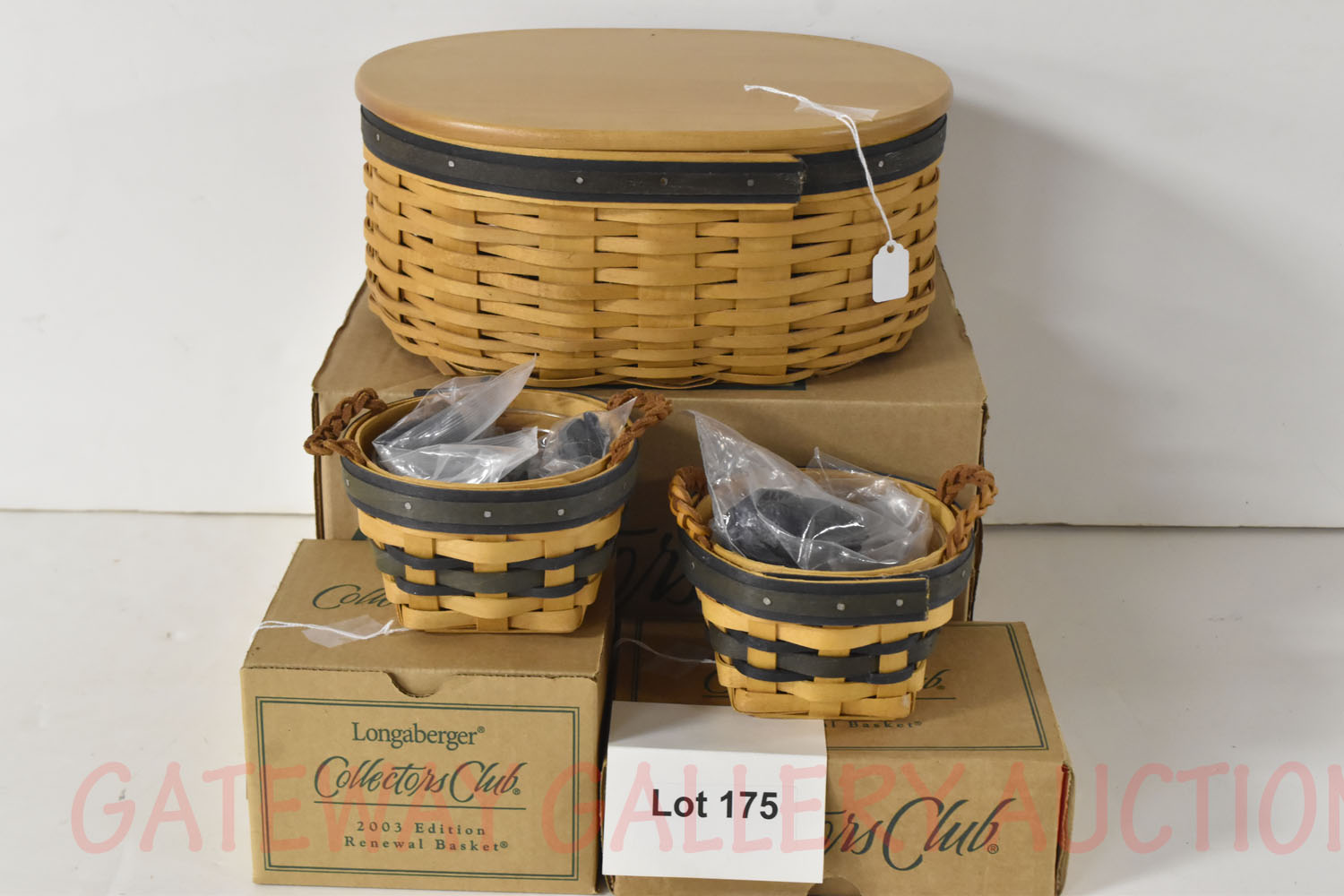
If you have fond memories of Longaberger Baskets or are searching for a basket you always wanted but never had, check out Gateway Gallery’s basket auction on Saturday, Feb. 7.
You’ll find a large collection (more than 300 lots) of Longaberger products from the estate of Terry L. Tritle, a local former sales advisor/director.
Ms. Tritle had many unique items and baskets in great condition, some like-new in original boxes.
Doors open for preview at 11 a.m. and auction begins promptly at 1 p.m., with live in-person and live online bidding through our website or download our mobile app.
Stop by and look at the baskets and memories they hold! — By Andrea Rose, Gateway Gallery Communications Coordinator